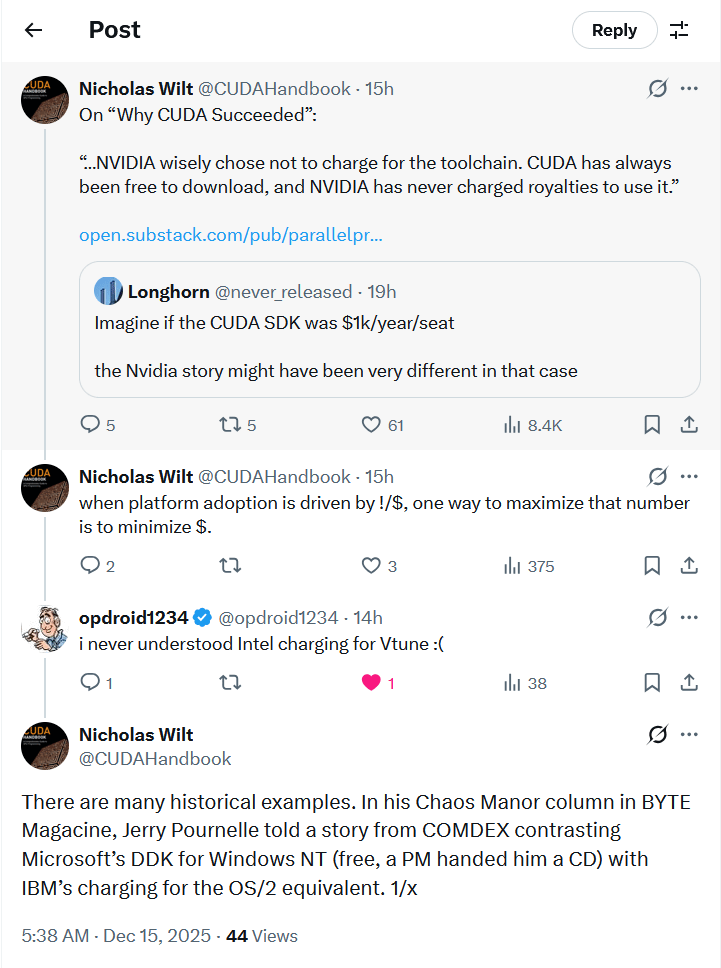
“Imagine if the CUDA SDK was $1k/year/seat,” the discussion began. Rhetorically, of course, since history has taught us that charging for platform support hinders adoption. @opdroid1234 wondered, “i never understood Intel charging for Vtune :(", the profiling tool that made it easy to profile applications to improve their performance on x86. As shown above, the discussion reminded me of a story that Jerry Pournelle, the legendary BYTE Magazine columnist1, had told at the height of the contest for mindshare between Window NT and OS/2.
It seems ridiculous today, but OS/2 once was considered as credible a successor to MS-DOS as Windows NT, which had originally been positioned as a microkernel operating system for which both Windows and OS/2 would be peer client operating systems. The competition referenced by Jerry Pournelle in the September 1993 issue of BYTE Magazine was the by-product of a so-called “divorce” between the two companies that started, according to this June 1992 New York Times article, in September 1990. Surprisingly, to me at least, the break occurred amidst an FTC investigation of collusion between the two companies that had started in the late 1980s2.
So by 1992, with Windows NT development going ahead full steam without any collaboration with IBM, the two companies were vying for market share and developer mindshare at conferences like COMDEX. Developers and consumers alike were being asked: operating system would provide the bigger return on investment?
And that is where distant past history intersects with our present discussion. I’ll let Pournelle take it from here (link to a PDF of the original pages of BYTE Magazine):
“Develop Your Device Drivers for OS/2!” proclaimed a sign at IBM’s booth. “IBM Device Driver Source Kit for OS/2 Now Available on CD!” A flier announced “Free. WIN-OS/2 source code for seamless VGA Display Device Driver when you order the DDK!” Microsoft has long used CD-ROMs to distribute their development kits, and will even get developers a discount on a CD-ROM drive.
Aha, I thought, now IBM has learned that trick. With any luck, we’ll soon see a flood of new device drivers for both OS/2 and Windows under OS/2, and maybe it won’t be long before I can hook up my Pioneer CD-ROM drive on an OS/2 system. By gum golly, it looks like IBM is doing something right.
Then I got closer, and to my horror, I saw the price. You can get the Device Driver Source Kit for only $4993. It wasn’t clear whether that was the regular price or a show special. I went up to the young woman who was passing out the fliers.
“I thought the big problem with OS/2 was the lack of device drivers,” I said. She gave me a smug look and handed me a flier. “Yeah,” I said, “but isn’t 500 bucks a bit steep? If I go over to Microsoft and whisper about writing device drivers for NT, they’ll stuff kit disks into my briefcase.” She drew herself up to her full height and said, “ Thank you very much for the information.” She was too polite to say, “We’re IBM. We don’t care. We don’t have to,” and maybe she didn’t think it, but it sure looked like she did.
I went around to some of the sharp OS/2 programmer troops and told that story. They were disturbed. They hadn’t known the price was that high. The kit, it seems, is sold by a different part of IBM. I spent an hour looking for any policy-level IBM official, or a PR officer, but I never found one to discuss this with. When I went back to the OS/2 station, the young woman, still smug, said, “ Back again?” It was pretty clear she had no use for my observations, so I didn’t offer any.
I didn’t know how much Microsoft charged for their kits, so I went over to find out. I’d no more than set foot on their carpet when one of the PR people recognized me4 and asked if she could help. “If I wanted to write NT device drivers, what should I do?” I asked. “ You’ re in the wrong booth,” she said. “Let’s go over to the NT booth. I don’t know anything about NT, but we’ll find someone.”
We walked over-no question that Microsoft’s PR people knew where each and every Microsoft booth and display was and in 7 minutes-I timed it-I was talking to one of the NT product managers. “Well, first you need the developer’s kit, with the compilers and source code and stuff,” he said. “That’s on a CD-ROM for $69. Then you get the DDK. It’s another CD-ROM, same price.”
“Little steep, isn’t it?” I said. “A little,” he said, “but there’s a lot there, all the sources we could find, not just ones we wrote but any we could talk people out of. Want a copy?” I think I just may have located the reason why there’s a shortage of OS/2 device drivers, and why there probably won’t be a shortage of NT drivers.
OS/2 was not a market success, and is not a viable platform today, in part because it did not deliver a high enough return on investment. Back then, the return came in the forms of application and, as Pournelle underscores above, hardware support; the investment required modest purchases of machines to develop the software, attending conferences, and learning how to use the tools and APIs. The smaller that denominator (that is, the lower the barrier to entry for hardware and software developers), the larger the return on investment. OS/2 made its mark on history, and the competitive pressures it exerted did influence operating system technology, but history will record it as a platform that failed in the marketplace.
There are notable examples of successful platforms with a high barrier to entry. I plan to write about those sometime soon.
Pournelle, of course, was much more than that, not least a Nebula-nominated novelist most famous for his collaborations with Larry Niven.
The FTC was particularly interested in whether Microsoft was able to parlay early knowledge of its operating system into competitive advantages in the applications market for that same operating system.
More than $1,100 in 2025 dollars.
Waxing delighted at being recognized, and getting special treatment, is vintage Pournelle. Later in the same column: “When I got home [from the conference], one of the first things to arrive on my doorstep was an Airborne Express package from Microsoft containing both kits on CD-ROM. I hadn’t even asked for them.”