The naive kernel threw out its reuse; drawing on rich tradition, a
CPU developer’s first instinct would be to block the loops so the
working set stays in cache.1 A GPU has real L1 and L2
caches too, so the same strategy applies. Give each thread a small
TM×TN microtile of C, keep
those accumulators in registers, and nest the loops so the strip of
A and B touched by a thread stays hot in cache – with
no shared memory at all.
template<int TM, int TN>__global__ void sgemm_cache( int M, int N, int K, const float *A, const float *B, float *C ){ for ( int row0 = (blockIdx.y*blockDim.y + threadIdx.y)*TM; row0 < M; row0 += gridDim.y*blockDim.y*TM ) { for ( int col0 = (blockIdx.x*blockDim.x + threadIdx.x)*TN; col0 < N; col0 += gridDim.x*blockDim.x*TN ) { float acc[TM][TN] = {}; for ( int k = 0; k < K; k++ ) { float a[TM], b[TN]; for ( int i = 0; i < TM; i++ ) a[i] = A[(row0+i)*K + k]; for ( int j = 0; j < TN; j++ ) b[j] = B[k*N + (col0+j)]; for ( int i = 0; i < TM; i++ ) { for ( int j = 0; j < TN; j++ ) acc[i][j] += a[i]*b[j]; } } // ... store acc[TM][TN] back to C ... } }}sgemm_cache).The block’s footprint – blockDim multiplied by the
microtile MT – specifies how much of A and
B stays resident, so the best value of MT is an
empirical question; on this GPU, sweeping the two tile parameters
independently, the best microtile size is 8×8. The cache-blocked kernel
reaches 3762 GFLOP/s, 4.2× the naive kernel, with only
register accumulation and the hardware caches capturing the reuse the
threads of a block share. The lesson to carry forward is that what
matters is reuse per thread: a thread that computes 64 outputs
from a strip of A and B amortizes each global load
across 64 multiply-adds.
Although blocking for the GPU caches is a real and nearly free first win, as we shall see in the next section, shared memory offers even more performance.
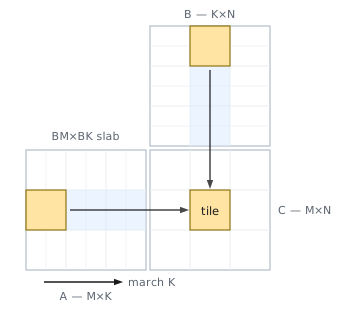
Figure 17-2. A thread block computes a BM×BN tile of C, marching the K dimension in BK-deep slabs of A and B.
The classic algorithm for turning a nested loop into a cache-blocked one – strip-mining and interchanging the loops so each tile’s working set fits in a level of cache – is Michael E. Wolf and Monica S. Lam, “A Data Locality Optimizing Algorithm,” in Proceedings of the ACM SIGPLAN 1991 Conference on Programming Language Design and Implementation (PLDI ’91), 30–44, https://suif.stanford.edu/papers/wolf91a.pdf. The GPU formulations in this chapter do by hand what that paper showed how to automate.↩︎