
When texturing with normalized coordinates, the texture is addressed by coordinates in the range [0.0, 1.0) instead of the range [0, MaxDim). For a 1D texture with 16 elements, the normalized coordinates are as follows:
Figure 10-6. Texturing with Normalized Coordinates
Other than having texture coordinates that are independent of the texture dimension, the texture is dealt with in largely the same way, except that the full range of CUDA’s texturing capabilities become available. With normalized coordinates, more texture addressing modes besides clamp and border addressing become available: the wrap and mirror addressing modes, whose formulas are as follows:
| Wrap | \[x^{'} = x - \left\lfloor x \right\rfloor\] |
|---|---|
| Mirror | \[x^{'} = \left\{ \begin{matrix} x - \left\lfloor x \right\rfloor,\ \left\lfloor x \right\rfloor\ is\ even \\ 1 - x - \left\lfloor x \right\rfloor,\ \left\lfloor x \right\rfloor\ is\ odd \end{matrix} \right.\ \] |
The four texture addressing modes supported in CUDA are depicted below, showing which in-range texture element is fetched by the first two out-of-range coordinates on each end.
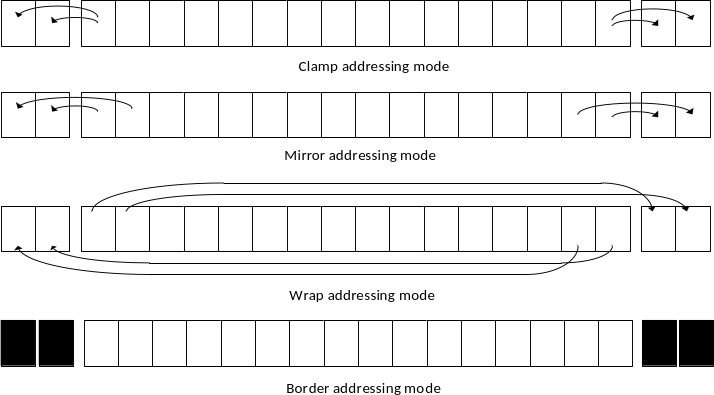
Figure 10-7. Texture Addressing Modes
If you are having trouble visualizing the behavior of these
addressing modes, check out the tex2d_opengl.cu microdemo
in the next section.
IMPORTANT NOTE: The addressing and filtering modes
are baked into a texture object when it is created. To texture the same
memory with a different addressing mode, create a second texture object
with a different cudaTextureDesc; the modes cannot be changed on an
existing object.
For applications that wish to use floating point coordinates to
address the texture, or use texturing features that are only available
for normalized coordinates, build the texture object from a
cudaResourceTypePitch2D resource that describes the device memory:
specify a height of 1 and a pitch of N*sizeof(T). The kernel can then
call tex2D()<T>(tex, x, 0.0f) to read the 1D texture with floating
point coordinates.