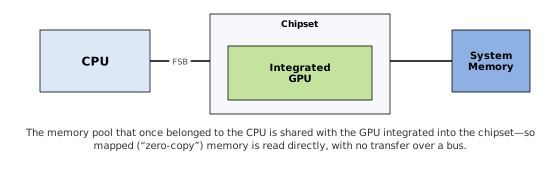
Historically, “integrated” meant integrated into the chipset, enabling the CPU and GPU to share a memory pool. Figure 2-9 illustrates the architecture for the earliest integrated GPUs from NVIDIA, which were built for the PC platform. As shown in the figure, the memory pool that previously had only belonged to the CPU is shared between the CPU and a GPU built into the chipset. NVIDIA shipped several such CUDA-capable chipsets—the MCP79, for laptops and netbooks, and the larger MCP89—before exiting the business, for reasons discussed below.
Figure 2-9. Integrated GPU.
On an integrated GPU, CUDA’s APIs for mapped pinned memory take on special importance. These APIs map a host allocation into the address space of CUDA kernels so they can read it directly; because the memory is physically shared, nothing need be copied over a bus, which is why the technique is also called “zero-copy.” For transfer-bound workloads, an integrated GPU can outperform a much larger discrete one.
“Write-combined” allocations matter here too: they inhibit cache snoops to the CPU, which speeds up GPU access to the memory—at the cost of the usual write-combined penalty if the CPU reads it back.
An integrated GPU does not preclude a discrete one. The MCP7x and
MCP89 chipsets also provided PCI Express connections (Figure 2-10), and
on such systems CUDA prefers the discrete GPU, since most CUDA
applications are written with discrete GPUs in mind—an application that
selects a single GPU will pick the discrete one automatically. A program
can ask whether a GPU is integrated through
cudaDeviceProp.integrated, or by passing
CU_DEVICE_ATTRIBUTE_INTEGRATED to
cuDeviceGetAttribute().
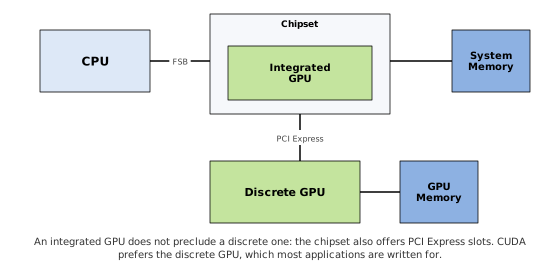
Figure 2-10. Integrated GPU with discrete GPU(s).
NVIDIA’s x86 chipsets depended on a license to Intel’s front-side bus. When Intel moved the memory controller onto the CPU die and shifted to its own DMI and QPI interconnects, they rescinded NVIDIA’s chipset license under the pretext that it did not cover NUMA architectures, and NVIDIA could no longer build chipsets for newer Intel processors. NVIDIA sued, and Intel’s rescission of the chipset license formed part of its theory of harm; Intel settled the suit in 2011, paying $1.5 billion in damages.6 MCP89—shipped exclusively in Apple’s 2010 Macs—was the last CUDA-capable x86 chipset NVIDIA made, and integrated x86 GPUs duly became the anachronism the first edition predicted.
The unified-memory idea did not go away, though; it moved to Arm. NVIDIA’s Tegra line integrates Arm CPU cores and a CUDA-capable GPU on a single system-on-chip (Figure 2-11) that share one physical memory pool—so the same zero-copy optimizations apply directly. Tegra parts power NVIDIA’s Jetson embedded modules and DRIVE automotive platforms, and are where most integrated CUDA GPUs live today.
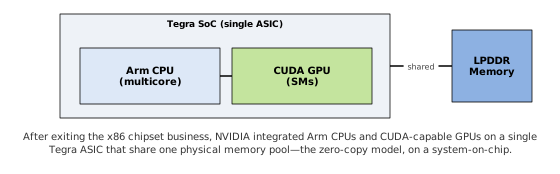
Figure 2-11. Tegra system-on-chip: an Arm CPU and a CUDA GPU on one ASIC.
The idea has since scaled all the way to supercomputer-sized clusters. The GB10 “Grace Blackwell” superchip (Figure 2-12) places a Grace Arm CPU and a Blackwell GPU on a single package and gives them one physically unified 128 GB LPDDR5X pool, kept coherent across the two dies over NVLink-C2C: genuine physical sharing, unlike the datacenter GB200, where the Grace CPU and the Blackwell GPU have disjoint LPDDR and HBM3e memories, respectively. Integrated CUDA GPUs, in other words, went from a low-end curiosity to the organizing principle of NVIDIA’s Arm-based systems, from the Jetson at the edge to a personal AI supercomputer on the desk.
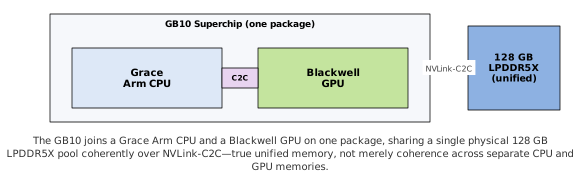
Figure 2-12. GB10 Grace Blackwell superchip: one package, one physically unified memory pool.
The rivalry and conflict between NVIDIA and Intel took a final turn when, in September 2025, the two companies announced a partnership—with NVIDIA taking a $5 billion stake in Intel—to co-develop products that couple Intel’s x86 CPUs with NVIDIA GPUs over NVLink, including x86 SoCs that integrate NVIDIA RTX GPU chiplets.7 The arrangement reverses the preclusion that had kept NVIDIA out of x86 integrated graphics since the 2011 settlement: one reasonable outcome to expect would be CUDA GPUs integrated with Intel processors.
Intel settled the suit in 2011, paying $1.5 billion. See “Intel Settles Nvidia Patent Suit For $1.5 Billion,” InformationWeek, January 2011. https://www.informationweek.com/it-infrastructure/intel-settles-nvidia-patent-suit-for-1-5-billion↩︎
“NVIDIA and Intel to Develop AI Infrastructure and Personal Computing Products,” NVIDIA newsroom, September 18, 2025. https://nvidianews.nvidia.com/news/nvidia-and-intel-to-develop-ai-infrastructure-and-personal-computing-products↩︎